aa.png)
A pair programming interview is less about producing flawless code alone and more about showing how you solve a problem with another engineer in the room. Clarify the task, explain meaningful decisions, invite feedback, test as you go, and treat a wrong turn as something to diagnose together. Your interviewer still needs to see independent judgment, but they also need to imagine working beside you on an ordinary Tuesday.
The best preparation is a realistic practice session, not another evening of silent algorithm drills. You should rehearse the technical work and the conversation around it: asking a useful question, making an assumption explicit, responding to a hint, and explaining what you would improve with more time.
What is the interviewer actually evaluating?
Your code matters, but it is only one stream of evidence. Pairing lets the interviewer see how you turn an unclear request into a workable task, whether you choose readable structures, how you react when a test fails, and whether another engineer can follow your reasoning. A solution that passes every test after forty minutes of silence may reveal less than a mostly complete solution developed through clear, sensible collaboration.
They are usually watching four things at once: problem framing, engineering judgment, communication, and adaptability. Problem framing means you identify inputs, outputs, constraints, and edge cases before committing to an approach. Engineering judgment appears in naming, decomposition, tests, and trade-offs. Communication is your ability to make key decisions visible without narrating every keystroke. Adaptability is how you use new information without becoming defensive or abandoning your own reasoning.
Do not mistake collaboration for asking permission before every line. A good pair has momentum. Make a reasonable choice, explain why it fits, and give the interviewer room to redirect you.
How should you prepare before the session?
Start with the format. Ask the recruiter which editor or platform you will use, whether you can run code and tests, whether documentation is allowed, which languages are available, and whether the exercise builds on a take-home submission. If the invitation names CoderPad or another collaborative editor, open its candidate sandbox beforehand and learn the run, test, reset, and language-selection controls. You should not spend interview time hunting for a basic button.
Then practice one problem at the expected difficulty while sharing your editor with a friend. Choose a task you can probably solve, because the goal is to train the interaction rather than prove you can survive an unusually hard algorithm. Ask your partner to interrupt once with a question, offer one useful hint, and challenge one design choice.
Use this short setup check before the call:
- Confirm the language version, editor, test runner, microphone, and screen-sharing permissions.
- Keep the role description and any permitted notes nearby, without covering your coding space.
- Close private tabs, notifications, password managers, and unrelated applications before sharing.
- Prepare water and connect power so a preventable interruption does not split your attention.
- Join early enough to fix audio or access trouble, but wait for the interviewer before changing shared code.
If you need a broader refresher on pacing and recovery, the live coding interview playbook covers the solo technical habits that still apply when another engineer joins the session.
What should you do in the first ten minutes?
Read the whole prompt before typing. Restate the task in your own words, then confirm the behavior with a small example. For a function that merges overlapping time ranges, you might say, "I think the output should be sorted, non-overlapping ranges, and touching ranges count as merged. Is that the behavior you want?" That sentence checks three assumptions without turning the opening into an interrogation.
Next, ask only questions that can change your design. Input size, malformed values, ordering guarantees, mutation rules, and performance expectations often matter. Questions such as "Should I optimize this?" are too vague. A better version is, "If the input can contain millions of ranges, I would sort once and scan in O(n log n). Is that scale relevant here?"
Outline your plan in two or three sentences. Name the data structure, the main loop or recursion, and the tests you want to run. If the interviewer agrees, start with a minimal working path. If they push back, you have discovered a constraint before investing in the wrong code.
How do you think aloud without becoming distracting?
Talk at decision points rather than reading your code aloud. Explain why you are choosing a map instead of a list, why you are extracting a helper, or why one edge case changes the loop condition. Ordinary syntax does not need commentary. "I am typing an if statement" adds noise; "I am handling an empty input here so the main loop can assume at least one element" exposes useful reasoning.
Short quiet periods are normal. When you need to trace state or remember an API, tell the interviewer what you are checking and take the pause. For example: "I want to walk through the indexes once before I change this condition." If the silence stretches beyond a minute or two, give a progress update: "The merge logic looks right for overlap, but I think I am advancing the left pointer too early. I am tracing that case now."
Keep the interviewer involved with specific invitations. "Does that assumption match how your team reads this requirement?" and "I see two reasonable representations; I am leaning toward the simpler one unless you want to explore update performance" create a technical conversation. Repeatedly asking "Is this okay?" makes it harder to see your own judgment.
How should you respond to hints and disagreement?
A hint is evidence, not a verdict on your ability. Pause, repeat the useful part in your own words, and connect it to the code. If the interviewer asks what happens with duplicate values, you could say, "That exposes a gap in my set-based approach because I would lose frequency. I will switch to a count map and keep the rest of the flow." This shows that you understood the signal and can update the design deliberately.
When you disagree, separate the technical point from the social moment. Try: "My concern with sorting in place is that the prompt says the caller may reuse the input. Would you prefer a copy, or should we treat mutation as allowed for this exercise?" You have defended a constraint while leaving room for a different decision.
Watch for three unhelpful reactions:
- Defending the original approach after new evidence has invalidated it.
- Accepting a suggestion immediately without showing that you understand its effect.
- Treating every interviewer question as a hidden correction and changing sound code at random.
The target is neither stubbornness nor obedience. It is calm technical judgment that improves when another person contributes information.
What do you do when the code fails?
Do not apologize your way through a failing test. Read the error, state what it rules out, and reduce the problem. Suppose a two-pointer solution returns the right values in the wrong order. You might say, "The membership logic is working, so I am going to inspect where results are appended rather than rewrite the search." Then create the smallest input that reproduces the ordering fault.
A useful debugging exchange sounds like this:
Interviewer: "What happens when both pointers reference the same value?"
Candidate: "Right now both branches can append it, so I can produce a duplicate. I will make equality its own branch, append once, and advance both pointers. Before changing it, I want a test with repeated values on both sides."
That answer identifies the defect, proposes a bounded fix, and adds a regression test. If you are truly stuck, summarize what you know and ask for a directional hint: "The parser creates the right tokens, and the failure starts when precedence changes. I have checked the stack push path. Could you point me toward the case you think I am missing?" A precise request is easier to help with than "I have no idea."
For visual or board-based problems, the same habit applies. The whiteboard interview practice drill is useful for rehearsing spoken reasoning when you cannot depend on an IDE to expose state.
How should you test and finish the exercise?
Begin with one normal case, then choose edge cases based on the code you wrote. Empty input, one element, duplicates, boundaries, invalid values, and unusually large inputs are candidates, not a ritual checklist. Explain why each test could break this implementation. If your loop uses i + 1, the last valid index deserves attention. If you mutate a collection during iteration, skipped elements matter more than a generic null test.
Leave a few minutes for a wrap-up. State what works, what remains incomplete, the complexity, and the first improvement you would make in production. A clear close might be: "The main path and duplicate case pass. I did not add malformed-input handling because we treated input as valid. Time is O(n log n) because of sorting, and the scan is linear. With more time I would separate validation and add property-based tests around overlapping ranges."
This is also the moment to acknowledge an intentional shortcut. Naming it yourself shows control over the solution rather than ignorance of the trade-off.
How can you run a realistic practice drill?
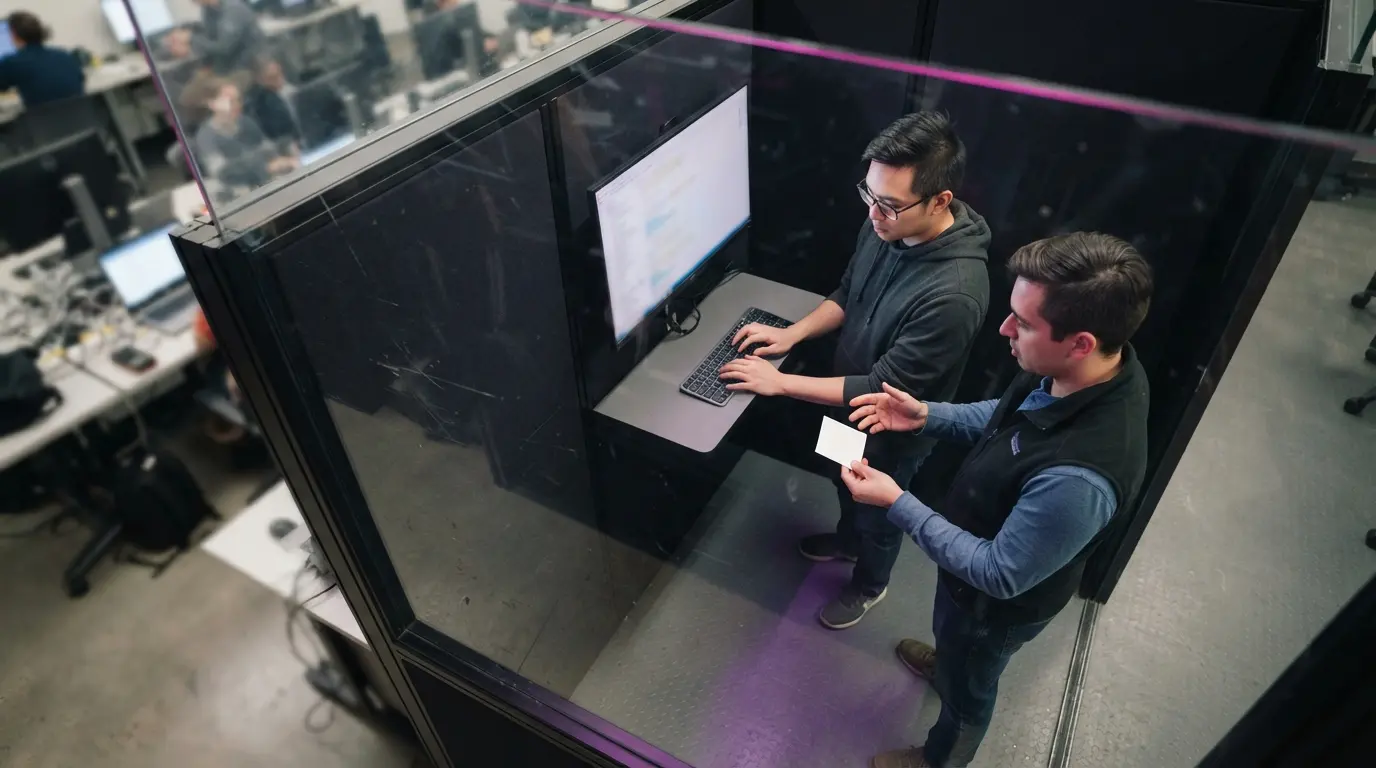
Set a 45-minute session with a partner and use a shared editor. Give yourself five minutes to clarify, five to outline, twenty-five to implement and test, and ten to review. Ask your partner to behave like an engaged colleague rather than a silent examiner. They should ask why, introduce one changed requirement, and offer one hint after you struggle for a reasonable period.
Score the session from one to five on four observable behaviors:
- Framing: did you confirm inputs, outputs, constraints, and a concrete example?
- Reasoning: did you explain decisions and trade-offs without narrating syntax?
- Collaboration: did you respond to questions, hints, and disagreement constructively?
- Delivery: did you test relevant risks and finish with an honest summary?
Repeat the drill with the same problem a few days later. The second attempt should feel more natural, but do not memorize a speech. Change one constraint so you still have to listen and adapt.
If you use Hiintly during practice, its free 10-minute session can surface live, resume-personalized answer suggestions and becomes available again after a 5-minute cooldown. During a real interview, first follow the employer's rules and use any assistance as support for your own reasoning, never as a substitute for the conversation your interviewer is evaluating.
What should you remember on interview day?
Treat the session as shared engineering work with an assessment attached. Clarify before you commit, make important reasoning visible, and let feedback improve the solution. When something breaks, reduce the problem and invite useful collaboration instead of hiding the mistake.
You do not need a perfect performance to leave strong evidence. You need the interviewer to see a developer who can understand a task, write sensible code, work through uncertainty, and make the person beside them more effective.
Frequently Asked Questions
- What is a pair programming interview?
- It is a technical interview where you solve or improve code while collaborating with an interviewer. They assess your reasoning, communication, testing habits, and response to feedback alongside the code itself.
- Should I talk constantly during a pair programming interview?
- No. Explain decisions, assumptions, and trade-offs, then allow short quiet stretches while you type or inspect an error. If silence runs long, give a brief update on what you are checking.
- What should I do if I disagree with the interviewer?
- State your reasoning calmly, ask what constraint their suggestion is addressing, and adapt when their direction is reasonable. A respectful technical disagreement can show judgment; defending every choice cannot.
- Can I use documentation during a pair programming interview?
- Ask before the session. Some interviewers allow normal documentation searches because that reflects real work, while others want a closed exercise. Confirm the rule rather than assuming.
- How should I practice for a pair programming interview?
- Practice with another person, share an editor, narrate key decisions, accept one or two deliberate hints, and finish by testing and summarizing. Review the recording or notes against a simple communication and engineering scorecard.