aa.png)
CodeSignal interview practice works best when it resembles the assessment you are about to take. Start with the invitation, rehearse under a realistic clock, and review why each mistake happened instead of grinding through random problems. A short series of deliberate sessions will teach you more than a giant question bank you barely remember.
What should CodeSignal interview practice actually prepare you for?
Your first job is to identify the event you have been invited to. An automated coding assessment and a collaborative live interview can both happen on CodeSignal, but they demand different habits. In an assessment, you may work independently and need to decide how to distribute your time. In a live interview, the quality of your questions, explanations, and response to feedback matters alongside the code.
Read the invitation, candidate instructions, permitted-language details, and any sample-test link before choosing practice problems. Employers can configure their processes differently, so a generic article cannot tell you exactly what your session will contain. The invitation is the closest thing you have to a specification.
Write down four facts: the session type, its scheduled length, the languages you may use, and whether a person will be present. If any point is unclear, ask the recruiter. That is a normal clarification, and it prevents you from rehearsing the wrong skill for a week.
The broader fundamentals still matter. CodeSignal's official advanced Java preparation path, for example, organizes work around arrays, hash maps, task decomposition, algorithms, and efficiency. Treat categories like these as a diagnostic menu, not a promise about the questions you will receive.
How do you build a practice loop from the invitation?
A useful loop has a narrow purpose and a visible result. Choose problems that expose a weakness, complete them under the conditions you expect, then use the evidence from that attempt to choose the next session. The following sequence keeps practice connected to the real event:
- Copy the known constraints from your invitation into a one-page practice note.
- Take any official sample or familiarization test before searching for third-party questions.
- Record which part slowed you down: understanding, approach, implementation, testing, or time control.
- Drill that specific failure with two or three related problems outside the mock.
- Run another timed mock and compare the new result with the previous one.
Do not change five things at once. If your last attempt failed because you misread edge cases, another week of advanced graph problems will not fix it. Practice restating inputs, outputs, and constraints, then write two test cases before coding. If you knew the approach but could not finish it, work on implementation fluency in your chosen language.
Keep the setup stable across mocks. Use the same language, a quiet room, and only the resources you expect to be allowed. The point is not to create an unpleasant boot camp. It is to remove surprises so your attention stays on the problem.
What should a realistic timed mock look like?
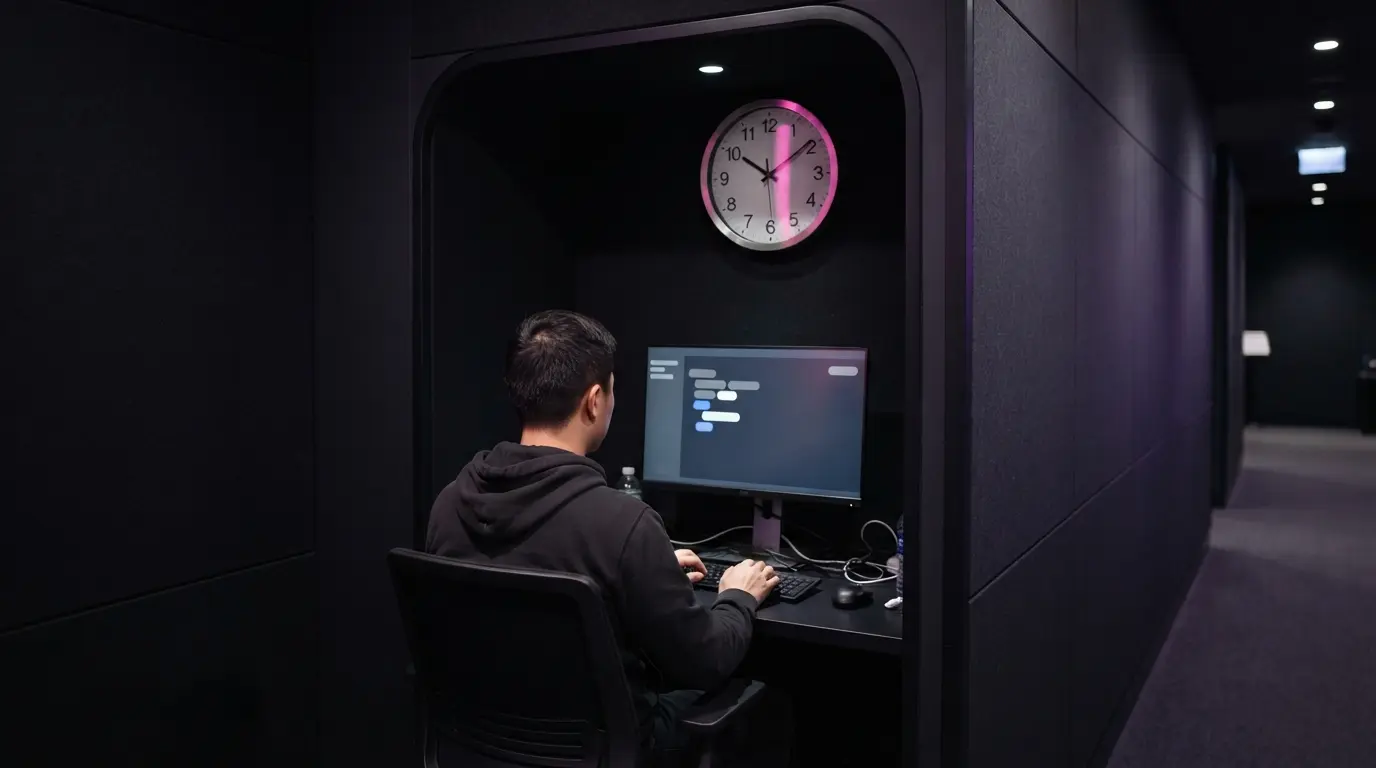
Use the duration in your invitation whenever possible. If you do not know it yet, practice in blocks long enough to make prioritization matter, rather than giving yourself unlimited time. A mock should include opening the prompt, deciding what to solve first, implementing, testing, and making a conscious decision to continue or move on.
At the start, scan the available work before committing. Look for a problem whose requirements you can restate clearly and whose basic solution you can implement cleanly. Early progress settles your nerves and gives you working code to test. Starting with the most intimidating prompt can consume the whole session before you have earned any points or useful feedback.
Reserve time for testing instead of treating it as whatever remains. Run the given examples, then add your own cases for empty or minimal input, boundaries, duplicates, ordering, and invalid assumptions where relevant. Read the prompt again after the first passing version. Many avoidable errors come from solving a slightly different problem with impressive-looking code.
When a solution works but seems inefficient, check the constraints before rewriting it. A simpler correct approach may be entirely appropriate. If the input size clearly makes it too slow, explain the bottleneck to yourself, identify the operation that repeats unnecessarily, and improve that part. Blind optimization is risky under a clock because it replaces known behavior with fresh bugs.
Which coding patterns deserve your attention?
Choose patterns from your own evidence. The official CodeSignal learning path currently highlights areas such as multidimensional arrays, hash maps, decomposition, two-pointer techniques, heaps, sorted lists, and efficiency analysis. Those are sensible practice categories, but your invitation and mistake log should decide the order.
| If your mock breaks here | Practice this next | Evidence that you improved |
|---|---|---|
| You cannot translate the prompt | Restating requirements and writing tiny examples | You can describe the input-output rule before touching code |
| Your idea is right but coding is slow | Language syntax and standard data-structure operations | You implement the same pattern with fewer pauses |
| Hidden cases keep failing | Boundary analysis and small adversarial tests | You predict failures before running the code |
| The solution times out | Complexity estimates and alternative data structures | You can name the bottleneck and justify the replacement |
| You freeze after a bug | Trace tables, logging, and binary isolation | You locate the failing assumption instead of rewriting everything |
Avoid memorizing a model solution line by line. Interview variants change the names, constraints, or required return value, and memorized code is brittle when one assumption moves. Learn the recognition cues and the reasoning behind the pattern. You want to be able to rebuild an approach, not recite it.
How should you review a failed practice session?
Review immediately while your decisions are still clear. Save the prompt name or category, your result, the time you spent, and the first moment the attempt went off course. Then assign one primary cause. A compact mistake log can use these categories:
- Interpretation: you misunderstood a rule, constraint, or expected output.
- Knowledge: you did not recognize the relevant data structure or algorithm.
- Implementation: you knew the approach but could not code it reliably.
- Testing: your solution missed a boundary, mutation, or ordering case.
- Time control: you stayed too long without changing strategy or moving on.
Write one correction beside the cause. “Do more coding” is too vague. “Before coding, write the smallest case and one duplicate-value case” gives you an action you can repeat. At the next mock, judge whether that correction changed your behavior, even if the final score is not yet where you want it.
This is also where you separate a bad result from a bad plan. One difficult prompt does not mean you need to restart your preparation. If the same failure appears across several sessions, it deserves a focused drill. If it appears once, note it and keep collecting evidence.
How do you practice explaining code in a live CodeSignal interview?
For a live session, silence can make correct work hard to evaluate. Practice stating what you understand, what you are assuming, and which option you are considering. You do not need to narrate every keystroke. Speak when your reasoning changes the direction of the solution.
A natural sequence is: restate the task, ask about an ambiguity, propose a simple approach, estimate its cost, and start with a small test. When feedback arrives, acknowledge it and decide whether it changes your assumptions or implementation. The goal is a real technical conversation, not a memorized monologue.
Our broader guide to live coding interviews covers clarification, thinking aloud, testing, and recovery in more depth. If the round is explicitly collaborative, use the pair programming interview guide to practice taking direction without surrendering your own judgment.
Record yourself solving one easy problem aloud. Listen for long unexplained gaps, premature certainty, and vague phrases such as “this should work”. Replace them with concrete reasoning: what invariant you are maintaining, what case you are testing, or why you chose one structure over another.
What should you do when you get stuck?
Getting stuck is part of the test, so rehearse a recovery routine before it happens. Your routine should help you produce information rather than stare at the editor:
- Restate the smallest version of the problem and solve it manually.
- Trace one example, naming the state that changes at each step.
- Write a straightforward solution, even if it may need optimization later.
- Set a time boundary for a new idea, then move on if the session allows it.
In a live interview, share the useful parts of this process. An interviewer can respond to a specific uncertainty but cannot help much with “I have no idea”. In an independent assessment, the same routine gives you a chance to earn progress and prevents one question from absorbing the entire clock.
Do not erase working code to chase elegance unless the constraints require a different approach. Keep a correct baseline, improve one part, and rerun the tests. Recovery is mostly about protecting good evidence while reducing uncertainty.
Can an AI copilot help with preparation?
An AI tool can be useful during practice when it acts as a reviewer rather than an answer vending machine. Ask it to challenge your assumptions, generate edge cases, or compare the complexity of two approaches after you have made an honest attempt. If it writes the full solution before you think, you lose the exact struggle that practice is supposed to train.
For a real interview, follow the employer's rules and the instructions for the session. A tool that is acceptable in personal preparation may not be permitted during an assessment. Never assume permission simply because software can run in the background.
When live assistance is allowed, Hiintly can listen during coding interviews on platforms such as CodeSignal and surface resume-personalized suggestions in a private overlay. The free 10-minute session becomes available again after a 5-minute cooldown, which makes it easy to test the workflow in a mock before deciding whether it suits you. Use suggestions as prompts for your own reasoning, and keep your explanation grounded in code you understand.
What does a seven-session practice plan look like?
The plan below is deliberately short. Repeat or expand a session if your invitation is weeks away, but keep the order: establish evidence, repair weaknesses, then rehearse the whole event.
| Session | Main work | Finish with |
|---|---|---|
| 1 | Read the invitation and take the official familiarization material | A baseline and one primary weakness |
| 2 | Drill the weak pattern without a full-session clock | Two solved examples and a short explanation of the pattern |
| 3 | Run a timed mixed mock | A mistake log with one cause per miss |
| 4 | Practice testing and debugging on previously solved problems | A repeatable edge-case checklist |
| 5 | Run a second timed mock with deliberate triage | A comparison with session 3 |
| 6 | If live, solve aloud and respond to feedback; if automated, rehearse independent recovery | One communication or time-control correction |
| 7 | Complete a final realistic mock, then stop heavy practice | A light review list for the day before |
Do not spend the final evening collecting unfamiliar advanced topics. Review the patterns you have already practiced, confirm your environment, and sleep. You want reliable access to what you know, not a crowded memory of half-learned tricks.
How do you know you are ready?
Readiness is not a streak of perfect solutions. You are ready when you can understand most prompts without panic, choose a defensible approach, implement common operations in your chosen language, test your assumptions, and recover when the first idea fails. For a live interview, add one more standard: you can explain decisions without turning the session into a performance.
Look at the last two or three mocks rather than your best attempt. Are the same errors repeating? Are you finishing more often because your decisions improved, not because you happened to recognize every problem? Can you name what you will do if the first question feels unfamiliar? Clear answers to those questions are better evidence than the number of problems you have opened.
Your final CodeSignal interview practice session should feel ordinary. The editor, clock, testing routine, and recovery steps should all be familiar enough that the actual interview can be about solving the problem in front of you.
Frequently Asked Questions
- How many days should I spend on CodeSignal interview practice?
- Use the time you have to complete at least two realistic timed mocks with focused review between them. Seven short sessions are enough to build a useful loop, while extra days should target repeated weaknesses rather than random new topics.
- Should I practice on CodeSignal itself?
- Start with any official familiarization or learning material available to you because it reduces interface surprises. You can use other problem sources for focused drills, but return to realistic conditions before the interview.
- What programming language should I use?
- Use a language permitted by the invitation that you can write, debug, and test fluently. Familiar syntax and standard-library knowledge usually matter more under time pressure than choosing a language because someone calls it optimal.
- Is a CodeSignal assessment the same as a live coding interview?
- No. An automated assessment emphasizes independent time and problem management, while a live interview also evaluates clarification, explanation, and response to feedback. Confirm the format in your invitation.
- What should I do if I cannot solve a practice problem?
- Shrink it to a tiny example, trace the state, write a straightforward baseline, and identify whether the block is interpretation, knowledge, implementation, testing, or time control. Use that diagnosis to choose the next drill.
- Can I use an AI assistant during a CodeSignal interview?
- Only if the employer and session rules allow it. AI can help review practice, generate edge cases, and challenge reasoning, but you should never assume it is permitted in a real assessment.